Author: marsten

What the Disability Voting Bloc Actually Needs from American Democracy


Published: Wednesday May 13, 2026
Featured image for “What the Disability Voting Bloc Actually Needs from American Democracy” showing a diverse group of disabled voters in front of a ballot box, including a blonde wheelchair user wearing an “I Voted” sticker, a Black woman casting a ballot, a blind man holding a white cane, a person signing, and another person holding a sign that says “Our Votes. Our Future.” The background includes a faint U.S. Capitol silhouette, patriotic red, white, blue brush strokes, and the series label “Disability & Democracy.”

Disabled Americans are not a political afterthought—they are one of the most powerful and misunderstood voting blocs in the country. This second installment in the Disability & Democracy series examines what the disability community actually needs from American democracy: accessible voting, protected civil rights, strengthened Medicaid and community-based services, accurate data, political recognition, and a democracy that understands disability rights as freedom infrastructure.
America’s Largest Untapped Swing Vote Is the Disability Community


Published: Thursday May 7, 2026
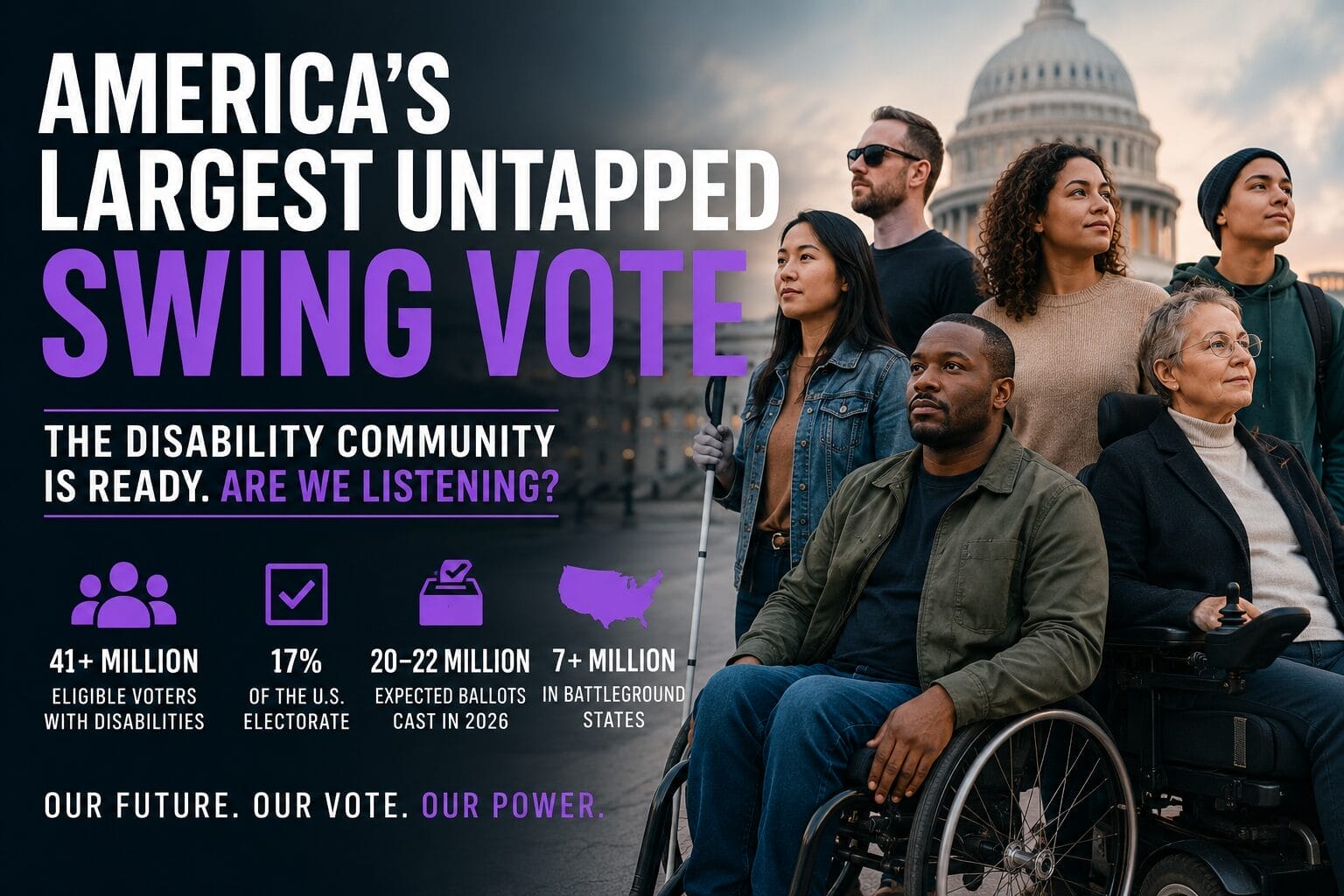
Editorial-style featured image for an article about the disability voting bloc in America. A diverse group of disabled adults stands and sits confidently in front of the U.S. Capitol building at dusk, including wheelchair users and a blind woman holding a white cane. Large bold text reads: “America’s Largest Untapped Swing Vote.” Additional text says: “The disability community is ready. Are we listening?” Statistics displayed on the image highlight more than 41 million eligible disabled voters, 17% of the U.S. electorate, 20–22 million expected ballots cast in 2026, and more than 7 million disabled voters in battleground states. The image uses dark blue and purple tones to convey urgency, political influence, and collective power.

More than 40 million disabled Americans are eligible to vote, making the disability community one of the largest — and least recognized — political constituencies in the United States. As economic uncertainty grows and debates around Medicare, Social Security, and accessibility intensify, disabled voters may become a decisive force in the 2026 midterms. This article explores the untapped political power of the disability electorate and why the conversation can no longer wait.

Celebrating GAAD: Accessibility Isn’t Just a Checkbox, It’s a Fundamental Culture Shift


Published: Thursday May 15, 2025
alycia wearing a black top and flower patterned skirt rolling down a ramp with painted red iron rails with a faded mural behind her

Accessibility is not simply about meeting compliance standards; it’s about fostering genuine inclusion. This Global Accessibility Awareness Day (GAAD), we recognize the cultural shift necessary to embed accessibility into every facet of our digital lives. From meaningful tech innovations to inclusive workplace practices, GAAD 2025 celebrates collective action. Let’s commit to viewing accessibility not as an obligation, but as an opportunity to build a universally inclusive future together.

Disability: The Market You Can’t Afford to Ignore


Published: Tuesday March 25, 2025
cartoon rendering of alycia in front of a whiteboard with pie charts graphs and stats holding a clipboard that says modern pathway to inclusion with checkboxes inclusion accessibility and diversity

The disability market represents over 1.85 billion people with $13 trillion in annual disposable income. Ignoring this influential group means missing massive economic potential. Prioritizing accessibility and inclusion drives innovation, expands your customer base, and strengthens brand loyalty. Discover why businesses that embrace disability inclusion gain a competitive edge in today’s market.

DREDF Hosts “Largest Meeting Ever” to Unite Advocates to Protect and Defend Section 504


Published: Thursday February 13, 2025
picture with the title rehabilitation act section 504 disability rights under attack showing a womans hand on the push rims of a wheelchair wheel and justice scales on top of a stack of books alongside a gavel

The Disability Rights Education & Defense Fund (DREDF) hosted its largest-ever gathering to protect and defend Section 504. This landmark event united advocates nationwide, reinforcing the critical importance of disability rights and accessibility. As we push forward, amplifying our voices and standing firm against challenges, this movement strengthens the future of inclusion. Join the fight for equity and accessibility!

Black History Month: Honoring Disabled Trailblazers


Published: Tuesday February 4, 2025
Image that reads black history vibes

Celebrate Black History Month by honoring Black disabled leaders who shaped both racial and disability rights movements. Learn about Brad Lomax, a key figure connecting the Black Panthers to the 504 Sit-In, and Johnnie Lacy, a trailblazer for disability advocacy in education. Discover how their resilience continues to inspire today’s activists, pushing for intersectional inclusion and justice. Their stories deserve the spotlight in shaping our collective history.

What do the new administration’s orders mean for people with disabilities?


Published: Saturday January 25, 2025

The new administration’s inaugural address signals shifts that threaten progress for people with disabilities, including DEI rollbacks, restrictive gender policies, in-person work mandates, aviation accessibility challenges, and withdrawal from the WHO. These actions risk eroding hard-fought disability rights and equity. The disability community must unite, remain vigilant, and advocate for inclusion and accessibility to preserve and advance progress under this administration.

What does pulling out of the World Health Organization (WHO) mean for people with disabilities?


Published: Saturday January 25, 2025
depicts the title of an executive order withdrawing from the world health organization posing a question about how this will effect people with disabilities

Leaving the World Health Organization (WHO) undermines U.S. leadership in global health equity, pandemic preparedness, and disability inclusion. As the leading contributor, America’s investments fostered goodwill, trust, and global cooperation. Withdrawal risks isolating the U.S., reducing access to critical disability-related resources like assistive technologies and inclusive healthcare policies, while weakening pandemic preparedness. This decision threatens progress for people with disabilities both domestically and worldwide.

How does ending DEI policies threaten disability rights in the United States?


Published: Saturday January 25, 2025
depicts the title of an executive order ending dei posing a question about how this will effect people with disabilities

The executive order aimed at reforming federal hiring practices threatens disability inclusion in both government and private sectors. By prioritizing merit-based hiring without addressing the unique barriers faced by disabled individuals, this policy risks further marginalizing them in employment opportunities. The shift away from affirmative action and diversity initiatives could deepen ableism and limit the ability of people with disabilities to access fair and equal job opportunities.

How do recent policies threaten air travel for people with disabilities?


Published: Saturday January 25, 2025
depicts the title of an executive order about safety in aviation posing a question about how this will effect people with disabilities

Decades of air travel mistreatment for people with disabilities saw progress under the Biden administration with fines, regulations, and DEI initiatives enhancing accessibility and accountability. However, recent actions by the Trump administration roll back these gains, labeling disability-inclusive FAA hiring as “illegal” and prioritizing ableist rhetoric over inclusivity. Only two of over 80 recent aviation actions address disability, risking accessibility and safety advancements for disabled travelers.